Leon Jenkins · 2 September 2026
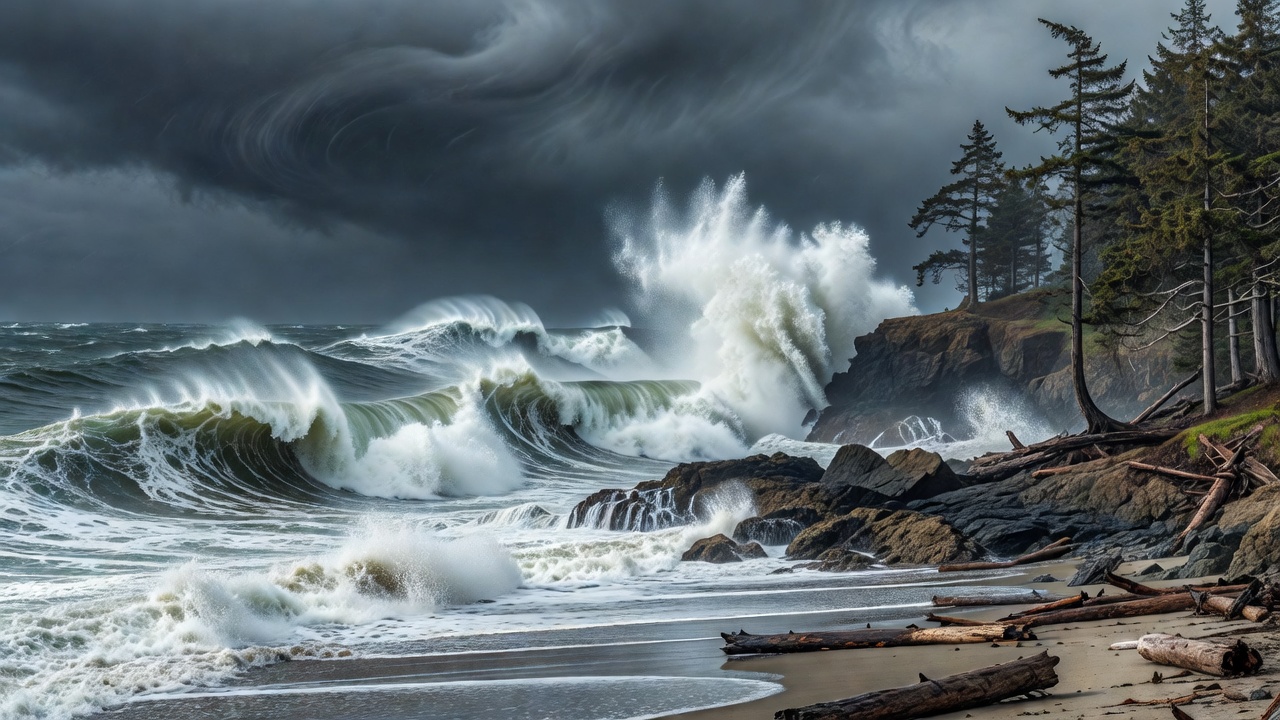
Powerful storms have intensified wave activity along the Pacific Northwest coast, with breaking waves reaching heights that challenge coastal infrastructure and ecosystems. Meteorologists report sustained winds exceeding 50 knots generating swells that propagate across the North Pacific, arriving with increased energy and steeper profiles that promote earlier breaking in shallower waters.
Wave Breaking Dynamics in Storm Conditions
Wave breaking occurs when orbital velocities at the crest exceed the phase speed, typically when the wave height to wavelength ratio surpasses 1:7. Storm forcing extends fetch and duration, elevating significant wave heights above 8 meters. Researchers employ phase-resolving models to simulate nonlinear interactions and energy dissipation rates, revealing that plunging breakers dominate during peak events and transfer momentum to the seabed more abruptly than spilling types. Field deployments of pressure sensors and acoustic Doppler profilers along Washington and Oregon shelves confirm dissipation concentrated within the surf zone, altering sediment transport patterns and increasing nearshore turbulence.
Climate analyses indicate a rising frequency of atmospheric rivers that coincide with extratropical cyclones, compounding wave energy. These conditions accelerate erosion at exposed headlands while depositing material in sheltered bays, reshaping intertidal habitats critical for forage fish and seabirds. Numerical forecasts now incorporate real-time buoy data to issue 48-hour warnings for wave run-up exceeding 4 meters, allowing emergency managers to stage sandbags and close vulnerable access points.
Coastal Impacts and Monitoring Advances
Communities from Neah Bay to Brookings face heightened risks of overtopping at jetties and seawalls constructed decades ago under milder wave climates. Insurance assessments project increased claims for property damage as mean sea level rise amplifies total water levels during storms. Continuous monitoring networks operated by federal and university partners track spectral wave parameters, enabling refinement of empirical breaking index formulas that account for directional spreading and bottom slope. Public dashboards display live exceedance probabilities, supporting adaptive strategies such as managed retreat in low-lying zones. Ongoing studies focus on how kelp forests and engineered submerged reefs might attenuate incoming wave energy before it reaches shore, offering nature-based options alongside traditional armoring.